
Plotting Two Variables Simultaneously
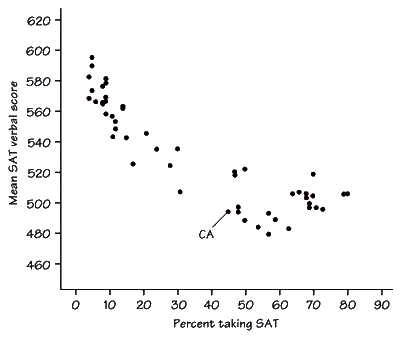
The more tightly the points are clustered together the higher the correlation between the two variables and the higher the ability to predict one variable from another.
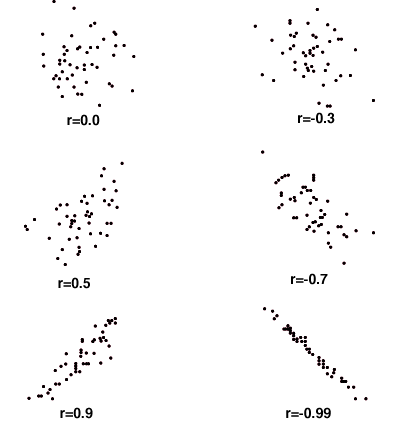
Correlation coefficients can take on any value between -1 and +1, with + and - 1 representing perfect correlations between the variables. And a correlation of zero representing no relationship between the variables.
A rule of thumb for interpreting correlation coefficients:
 Corr     Interpretation
 0 to .1  trivial
.1 to .3  small
.3 to .5  moderate
.5 to .7  large
.7 to .9  very large
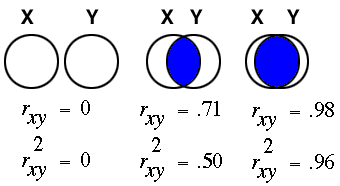
Correlations are interpreted by squaring the value of the correlation coefficient. The squared value represents the proportion of variance of one variace that is shared with the other variable, in other words, the proportion of the variance of one variable that can be predicted from the other variable.
corr   n
.10   617
.20   153
.30    68
.40    37
.50    22
.60    15
.70    10
.80     7
.90     5
Sources of Misleading Correlation Coefficients
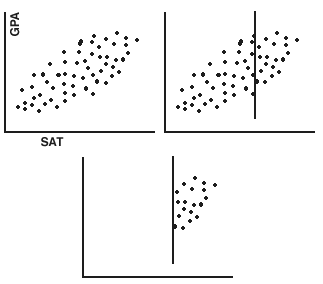
Restriction of Range
Extreme Groups
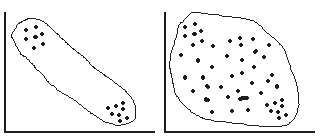
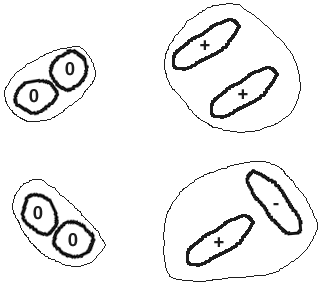
Combining Groups
Outliers
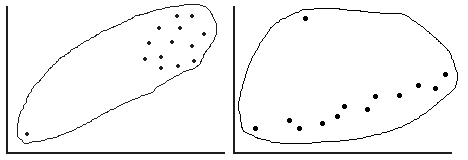
Curvilinearity
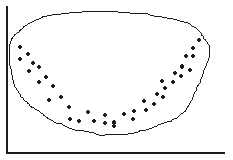
Discuss Correlation & Causation
Of course, just because two variables are correlated it does not mean that they are causally related. Often a third variable, a lurking variable, that is not included in the analysis is responsible (causes) for the first two variables. A lurking variable is a variable that loiters in the background and affects both of the original variables
Other Correlation Coefficients
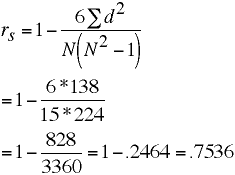
Spearman Example
| Sub | xrank | yrank | d | d2 |
| a | 1 | 3 | -2 | 4 |
| b | 4 | 4 | 0 | 0 |
| c | 5 | 8 | -3 | 9 |
| d | 10 | 5 | 5 | 25 |
| e | 8 | 2 | 6 | 36 |
| f | 14 | 15 | -1 | 1 |
| g | 7 | 9 | -2 | 4 |
| h | 2 | 6 | -4 | 16 |
| i | 12 | 14 | -2 | 4 |
| j | 9 | 7 | 2 | 4 |
| k | 15 | 13 | 2 | 4 |
| l | 3 | 1 | 2 | 4 |
| m | 13 | 12 | 1 | 1 |
| n | 11 | 10 | 1 | 1 |
| o | 6 | 11 | -5 | 25 |
| Sum | 0 | 138 |
Stata Example
input xrank yrank
 1  3
 4  4
 5  8
10  5
 8  2
14 15
 7  9
 2  6
12 14
 9  7
15 13
 3  1
13 12
11 10
 6 11
end

corr
(obs=15)

         |    xrank    yrank
---------+------------------
   xrank |   1.0000
   yrank |   0.7536   1.0000
Another Stata Example
input y x
100 135
120 105
160 155
220 175
110 105
140 145
200 185
260 195
130 145
110 105
180 175
210 165
200 175
170 145
120 145
end

egen xrank = rank(x)

egen yrank = rank(y)

list

             y          x      xrank      yrank
  1.       100        135          4          1
  2.       110        105          2        2.5
  3.       110        105          2        2.5
  4.       120        145        6.5        4.5
  5.       120        105          2        4.5
  6.       130        145        6.5          6
  7.       140        145        6.5          7
  8.       160        155          9          8
  9.       170        145        6.5          9
 10.       180        175         12         10
 11.       200        185         14       11.5
 12.       200        175         12       11.5
 13.       210        165         10         13
 14.       220        175         12         14
 15.       260        195         15         15

corr x y xrank yrank
(obs=15)

         |        y        x    xrank    yrank
---------+------------------------------------
       y |   1.0000
       x |   0.8768   1.0000
   xrank |   0.9118   0.9853   1.0000
   yrank |   0.9821   0.8753   0.9073   1.0000

spearman x y

 Number of obs =      15
Spearman's rho =       0.9073

Test of Ho: x and y independent
      Pr > |t| =       0.0000
Point Biserial Correlation
Point Biserial Example
input y x
100 0
120 1
160 0
220 1
110 0
140 0
200 1
260 1
130 0
110 1
180 0
210 1
200 1
170 1
120 0
end

corr x y
(obs=15)

         |        x        y
---------+------------------
       x |   1.0000
       y |   0.5541   1.0000
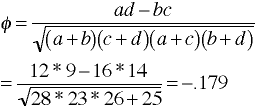
Fourfold Correlation - Phi Coefficient
| Y | ||||
| 1 | 0 | |||
| X | 1 | (a) 12 | (b) 16 | |
| 0 | (c) 14 | (d) 9 | ||
Stata Example
input x y w
0 0 9
0 1 14
1 0 16
1 1 12
end

corr x y [fw=w]
(obs=51)

         |        x        y
---------+------------------
       x |   1.0000
       y |  -0.1793   1.0000
tab x y [fw=w], all

           |           y
         x |         0          1 |     Total
-----------+----------------------+----------
         0 |         9         14 |        23
         1 |        16         12 |        28
-----------+----------------------+----------
     Total |        25         26 |        51

          Pearson chi2(1) =   1.6394   Pr = 0.200
 likelihood-ratio chi2(1) =   1.6495   Pr = 0.199
               Cramer's V =  -0.1793
                    gamma =  -0.3494  ASE = 0.252
          Kendall's tau-b =  -0.1793  ASE = 0.138
When analyzing two-by-two tables, the value of Cramer's V is actually phi. Cramer's V is a generalization of the phi coefficient that can be used in tables larger than two-by-two.