The hypotheses are concerned with variances.
Random-effects Hypotheses
A Main Effect --
H0: σ2α = 0;
H1: σ2α ≠ 0
B Main Effect --
H0: σ2β = 0;
H1: σ2β ≠ 0
A*B Interaction --
H0: σ2αβ = 0;
H1: σ2αβ ≠ 0
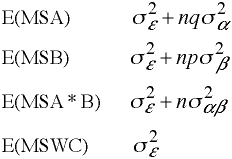
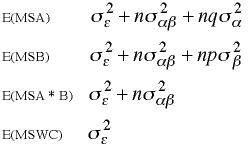
Random-Effects Expected Mean Squares
Random-effects ANOVA Summary Table
| Source | SS | df | MS | F | Error Term
|
| A Main effect | 190.000 | 2 | 95.000 | .31 | MS A*B
|
| B Main effect | 1543.333 | 2 | 771.666 | 2.50 | MS A*B
|
| A*B Interaction | 1236.667 | 4 | 309.167 | 4.95 | MS WCell
|
| Within Cells | 2250.000 | 36 | 62.500
|
| Total | 5220.000 | 44
|
Strength of Association
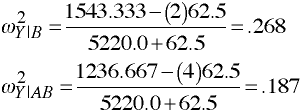
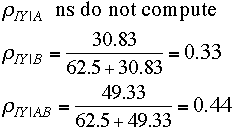
Partial Intraclass Correlation
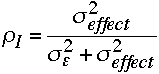
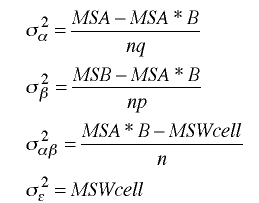
Computing variance components:
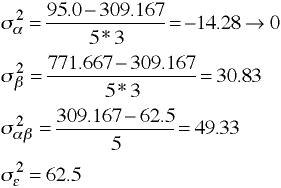
Variance components from the example above:
Partial intraclass correlations from the example above:
Mixed-effects Model
In a design with two independent variables there are two different mixed-effects models possible:
- A fixed & B random, or
- A random & B fixed
A fixed & B random Hypotheses
A Main Effect --
H0: αj = 0 for all j;
H1: αj ≠ 0 for some j
B Main Effect --
H0: σ2β = 0;
H1: σ2β ≠ 0
A*B Interaction --
H0: σ2αβ = 0;
H1: σ2αβ ≠ 0
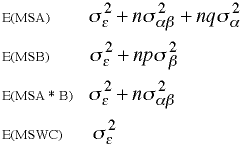
A fixed & B random Expected Mean Squares
A fixed & B random ANOVA Summary Table
| Source | SS | df | MS | F | Error Term
|
| A Main effect | 190.000 | 2 | 95.000 | .31 | MS A*B
|
| B Main effect | 1543.333 | 2 | 771.666 | 12.35 | MS WCell
|
| A*B Interaction | 1236.667 | 4 | 309.167 | 4.95 | MS WCell
|
| Within Cells | 2250.000 | 36 | 62.500
|
| Total | 5220.000 | 44
|
Why does the fixed variable use interaction as the error term?
According to Hays' (2nd Ed) in a two-way design in which A (the columns) is fixed and
B (the rows) is random,
the levels of B represent a random sample from the population of possible levels.
Hays points out that the deviation of a column mean from the grand mean includes not only
column effects and mean error deviation but also includes a deviation due to interaction
effect of the cell mean from the grand cell mean (cj - Mc). The reason that this is so
is that there is no requirement that the interaction effects sum to zero across the rows
when the row treatment effects and thus the the interaction effects are only a random
sample of such effects. Thus, column means formed by summing across rows contain not
only fixed column effects but also some random interaction effects.
A random & B fixed Hypotheses
A Main Effect --
H0: σ2α = 0;
H1: σ2α ≠ 0
B Main Effect --
H0: βk = 0 for all k;
H1: βk ≠ 0 for some k
A*B Interaction --
H0: σ2αβ = 0;
H1: σ2αβ ≠ 0
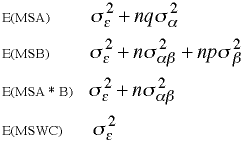
A random & B fixed Expected Mean Squares
A random & B fixed ANOVA Summary Table
| Source | SS | df | MS | F | Error Term
|
| A Main effect | 190.000 | 2 | 95.000 | 1.52 | MS WCell
|
| B Main effect | 1543.333 | 2 | 771.666 | 2.50 | MS A*B
|
| A*B Interaction | 1236.667 | 4 | 309.167 | 4.95 | MS WCell
|
| Within Cells | 2250.000 | 36 | 62.500
|
| Total | 5220.000 | 44
|
Using Stata
Example problem taken from
Completely Randomized Factorial Design
use http://www.philender.com/courses/data/crf33, clear

anova y a b a#b  /* fixed effects model */

                           Number of obs =      45     R-squared     =  0.5690
                           Root MSE      = 7.90569     Adj R-squared =  0.4732

                  Source |  Partial SS    df       MS           F     Prob > F
              -----------+----------------------------------------------------
                   Model |        2970     8      371.25       5.94     0.0001
                         |
                       a |         190     2          95       1.52     0.2324
                       b |  1543.33333     2  771.666667      12.35     0.0001
                     a#b |  1236.66667     4  309.166667       4.95     0.0028
                         |
                Residual |        2250    36        62.5
              -----------+----------------------------------------------------
                   Total |        5220    44  118.636364

anova y a b / a#b /  /* random effects model */

                           Number of obs =      45     R-squared     =  0.5690
                           Root MSE      = 7.90569     Adj R-squared =  0.4732

                  Source |  Partial SS    df       MS           F     Prob > F
              -----------+----------------------------------------------------
                   Model |        2970     8      371.25       5.94     0.0001
                         |
                       a |         190     2          95       0.31     0.7514
                       b |  1543.33333     2  771.666667       2.50     0.1979
                     a#b |  1236.66667     4  309.166667
              -----------+----------------------------------------------------
                     a#b |  1236.66667     4  309.166667       4.95     0.0028
                         |
                Residual |        2250    36        62.5
              -----------+----------------------------------------------------
                   Total |        5220    44  118.636364

anova y  a b a#b  /* mixed effects model: a fixed; b random */

                           Number of obs =      45     R-squared     =  0.5690
                           Root MSE      = 7.90569     Adj R-squared =  0.4732

                  Source |  Partial SS    df       MS           F     Prob > F
              -----------+----------------------------------------------------
                   Model |        2970     8      371.25       5.94     0.0001
                         |
                       a |         190     2          95       1.52     0.2324
                       b |  1543.33333     2  771.666667      12.35     0.0001
                     a#b |  1236.66667     4  309.166667       4.95     0.0028
                         |
                Residual |        2250    36        62.5
              -----------+----------------------------------------------------
                   Total |        5220    44  118.636364

test a / a#b

                  Source |  Partial SS    df       MS           F     Prob > F
              -----------+----------------------------------------------------
                       a |         190     2          95       0.31     0.7514
                     a#b |  1236.66667     4  309.166667

anova y  a  b a#b  /* mixed effects model: b fixed; a random */

                           Number of obs =      45     R-squared     =  0.5690
                           Root MSE      = 7.90569     Adj R-squared =  0.4732

                  Source |  Partial SS    df       MS           F     Prob > F
              -----------+----------------------------------------------------
                   Model |        2970     8      371.25       5.94     0.0001
                         |
                       a |         190     2          95       1.52     0.2324
                       b |  1543.33333     2  771.666667      12.35     0.0001
                     a#b |  1236.66667     4  309.166667       4.95     0.0028
                         |
                Residual |        2250    36        62.5
              -----------+----------------------------------------------------
                   Total |        5220    44  118.636364

test b / a#b

                  Source |  Partial SS    df       MS           F     Prob > F
              -----------+----------------------------------------------------
                       b |  1543.33333     2  771.666667       2.50     0.1979
                     a#b |  1236.66667     4  309.166667
Using Orthogonal Coding
Example problem taken from
Completely Randomized Factorial Design
input a b y x1 x2 x3 x4
1 1 24  1  1  1  1
1 1 33  1  1  1  1
1 1 37  1  1  1  1
1 1 29  1  1  1  1
1 1 42  1  1  1  1
1 2 44  1  1 -1  1
1 2 36  1  1 -1  1
1 2 25  1  1 -1  1
1 2 27  1  1 -1  1
1 2 43  1  1 -1  1
1 3 38  1  1  0 -2
1 3 29  1  1  0 -2
1 3 28  1  1  0 -2
1 3 47  1  1  0 -2
1 3 48  1  1  0 -2
2 1 30 -1  1  1  1
2 1 21 -1  1  1  1
2 1 39 -1  1  1  1
2 1 26 -1  1  1  1
2 1 34 -1  1  1  1
2 2 35 -1  1 -1  1
2 2 40 -1  1 -1  1
2 2 27 -1  1 -1  1
2 2 31 -1  1 -1  1
2 2 22 -1  1 -1  1
2 3 26 -1  1  0 -2
2 3 27 -1  1  0 -2
2 3 36 -1  1  0 -2
2 3 46 -1  1  0 -2
2 3 45 -1  1  0 -2
3 1 21  0 -2  1  1
3 1 18  0 -2  1  1
3 1 10  0 -2  1  1
3 1 31  0 -2  1  1
3 1 20  0 -2  1  1
3 2 41  0 -2 -1  1
3 2 39  0 -2 -1  1
3 2 50  0 -2 -1  1
3 2 36  0 -2 -1  1
3 2 34  0 -2 -1  1
3 3 42  0 -2  0 -2
3 3 52  0 -2  0 -2
3 3 53  0 -2  0 -2
3 3 49  0 -2  0 -2
3 3 64  0 -2  0 -2
end

generate x5 = x1*x3
generate x6 = x1*x4
generate x7 = x2*x3
generate x8 = x2*x4

regress y x1 x2 x3 x4 x5 x6 x7 x8

  Source |       SS       df       MS                  Number of obs =      45
---------+------------------------------               F(  8,    36) =    5.94
   Model |     2970.00     8      371.25               Prob > F      =  0.0001
Residual |     2250.00    36       62.50               R-squared     =  0.5690
---------+------------------------------               Adj R-squared =  0.4732
   Total |     5220.00    44  118.636364               Root MSE      =  7.9057

------------------------------------------------------------------------------
       y |      Coef.   Std. Err.       t     P>|t|       [95% Conf. Interval]
---------+--------------------------------------------------------------------
      x1 |        1.5   1.443376      1.039   0.306      -1.427302    4.427302
      x2 |  -1.166667   .8333333     -1.400   0.170      -2.856745    .5234117
      x3 |  -3.833333   1.443376     -2.656   0.012      -6.760635   -.9060318
      x4 |       -3.5   .8333333     -4.200   0.000      -5.190078   -1.809922
      x5 |       -.25   1.767767     -0.141   0.888      -3.835198    3.335198
      x6 |        .25   1.020621      0.245   0.808      -1.819915    2.319915
      x7 |   3.083333   1.020621      3.021   0.005       1.013419    5.153248
      x8 |   1.916667   .5892557      3.253   0.002       .7216008    3.111733
   _cons |         35   1.178511     29.698   0.000       32.60987    37.39013
------------------------------------------------------------------------------

test x1 x2 /*  using residual as error */

 ( 1)  x1 = 0.0
 ( 2)  x2 = 0.0

       F(  2,    36) =    1.52
            Prob > F =    0.2324

test x3 x4 /*  using residual as error */

 ( 1)  x3 = 0.0
 ( 2)  x4 = 0.0

       F(  2,    36) =   12.35
            Prob > F =    0.0001

test x5 x6 x7 x8 /*  using residual as error */

 ( 1)  x5 = 0.0
 ( 2)  x6 = 0.0
 ( 3)  x7 = 0.0
 ( 4)  x8 = 0.0

       F(  4,    36) =    4.95
            Prob > F =    0.0028


regress y x1 x2

  Source |       SS       df       MS                  Number of obs =      45
---------+------------------------------               F(  2,    42) =    0.79
   Model |      190.00     2       95.00               Prob > F      =  0.4590
Residual |     5030.00    42  119.761905               R-squared     =  0.0364
---------+------------------------------               Adj R-squared = -0.0095
   Total |     5220.00    44  118.636364               Root MSE      =  10.944

------------------------------------------------------------------------------
       y |      Coef.   Std. Err.       t     P>|t|       [95% Conf. Interval]
---------+--------------------------------------------------------------------
      x1 |        1.5   1.998015      0.751   0.457      -2.532157    5.532157
      x2 |  -1.166667   1.153554     -1.011   0.318      -3.494634      1.1613
   _cons |         35   1.631372     21.454   0.000       31.70776    38.29224
------------------------------------------------------------------------------

regress y x3 x4

  Source |       SS       df       MS                  Number of obs =      45
---------+------------------------------               F(  2,    42) =    8.82
   Model |  1543.33333     2  771.666667               Prob > F      =  0.0006
Residual |  3676.66667    42  87.5396825               R-squared     =  0.2957
---------+------------------------------               Adj R-squared =  0.2621
   Total |     5220.00    44  118.636364               Root MSE      =  9.3563

------------------------------------------------------------------------------
       y |      Coef.   Std. Err.       t     P>|t|       [95% Conf. Interval]
---------+--------------------------------------------------------------------
      x3 |  -3.833333   1.708212     -2.244   0.030      -7.280645   -.3860213
      x4 |       -3.5   .9862369     -3.549   0.001      -5.490307   -1.509693
   _cons |         35    1.39475     25.094   0.000       32.18528    37.81472
------------------------------------------------------------------------------

regress y x5 x6 x7 x8

  Source |       SS       df       MS                  Number of obs =      45
---------+------------------------------               F(  4,    40) =    3.10
   Model |  1236.66667     4  309.166667               Prob > F      =  0.0257
Residual |  3983.33333    40  99.5833333               R-squared     =  0.2369
---------+------------------------------               Adj R-squared =  0.1606
   Total |     5220.00    44  118.636364               Root MSE      =  9.9791

------------------------------------------------------------------------------
       y |      Coef.   Std. Err.       t     P>|t|       [95% Conf. Interval]
---------+--------------------------------------------------------------------
      x5 |       -.25   2.231405     -0.112   0.911      -4.759837    4.259837
      x6 |        .25   1.288302      0.194   0.847      -2.353756    2.853756
      x7 |   3.083333   1.288302      2.393   0.021       .4795777    5.687089
      x8 |   1.916667   .7438015      2.577   0.014       .4133877    3.419946
   _cons |         35   1.487603     23.528   0.000       31.99344    38.00656
------------------------------------------------------------------------------


Regression Results Summarized

model m0:      R-square       0.5690
model m1:      R-square       0.0364
model m2:      R-square       0.2957
model m3:      R-square       0.2369
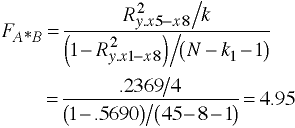
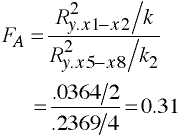
Random-Effects F-ratios Using Regression
F-ratio for B main effect
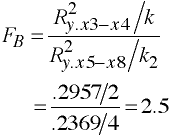
With 2 & 4 degrees of freedom
Random & Mixed Effects Using test2
The test2 command (available from ATS) can be used to perform tests with different
error terms after using regress. The test2 command is an alternative to
computing the F-ratio manually.
regress y x1 x2 x3 x4 x5 x6 x7 x8

      Source |       SS       df       MS              Number of obs =      45
-------------+------------------------------           F(  8,    36) =    5.94
       Model |     2970.00     8      371.25           Prob > F      =  0.0001
    Residual |     2250.00    36       62.50           R-squared     =  0.5690
-------------+------------------------------           Adj R-squared =  0.4732
       Total |     5220.00    44  118.636364           Root MSE      =  7.9057

------------------------------------------------------------------------------
           y |      Coef.   Std. Err.      t    P>|t|     [95% Conf. Interval]
-------------+----------------------------------------------------------------
          x1 |        1.5   1.443376     1.04   0.306    -1.427302    4.427302
          x2 |  -1.166667   .8333333    -1.40   0.170    -2.856745    .5234117
          x3 |  -3.833333   1.443376    -2.66   0.012    -6.760635   -.9060318
          x4 |       -3.5   .8333333    -4.20   0.000    -5.190078   -1.809922
          x5 |       -.25   1.767767    -0.14   0.888    -3.835198    3.335198
          x6 |        .25   1.020621     0.24   0.808    -1.819915    2.319915
          x7 |   3.083333   1.020621     3.02   0.005     1.013419    5.153248
          x8 |   1.916667   .5892557     3.25   0.002     .7216008    3.111733
       _cons |         35   1.178511    29.70   0.000     32.60987    37.39013
------------------------------------------------------------------------------

test2 x1 x2 / x5 x6 x7 x8  /* using A*B as error */

Testing: x1 x2
Error term: x5 x6 x7 x8

     F(  2,   4)  =  .31
         Prob > F = 0.7514

test2 x3 x4 / x5 x6 x7 x8  /* using A*B as error */

Testing: x3 x4
Error term: x5 x6 x7 x8

     F(  2,   4)  =  2.50
         Prob > F =  0.1979

test x5 x6 x7 x8  /* using residual as error */

 ( 1)  x5 = 0.0
 ( 2)  x6 = 0.0
 ( 3)  x7 = 0.0
 ( 4)  x8 = 0.0

       F(  4,    36) =    4.95
            Prob > F =    0.0028
Linear Statistical Models Course
Phil Ender, 24sep10, 29apr06, 12Feb98