
Using the hsb2 dataset, consider the correlation between science and math.
use http://www.gseis.ucla.edu/courses/data/hsb2

 corr science math
(obs=200)

             |  science     math
-------------+------------------
     science |   1.0000
        math |   0.6307   1.0000
The correlation of 0.63 may be satisfyingly large but it is also somewhat misleading.
It would be tempting to interpret the correlation as reflecting the relationship between a measure
of ability in science and ability in math. The problem is that both the science and math tests
are standardized written tests so that general academic skills and intelligence are likely to
influence the results of both, leading to an inflated correlation. In addition to the inflated
correlation there is a more subtle problem that can arise when you try to use these test scores in
a regression analysis. Consider the following model:
Because portions of the variability of both science and math are jointly determined by general academic skills and intelligence there is a strong likelihood that there will be a correlation between math and the error (residuals) in the model. This correlation violates one of the basic assumptions of independence in OLS regression. Using reading and writing scores as indicators of general academic skills and intelligence, we can check out this possibility with the following commands.
regress math female read write

      Source |       SS       df       MS              Number of obs =     200
-------------+------------------------------           F(  3,   196) =   72.33
       Model |  9176.66954     3  3058.88985           Prob > F      =  0.0000
    Residual |  8289.12546   196  42.2914564           R-squared     =  0.5254
-------------+------------------------------           Adj R-squared =  0.5181
       Total |   17465.795   199  87.7678141           Root MSE      =  6.5032

------------------------------------------------------------------------------
        math |      Coef.   Std. Err.      t    P>|t|     [95% Conf. Interval]
-------------+----------------------------------------------------------------
      female |  -2.023984    .991051    -2.04   0.042    -3.978476   -.0694912
        read |    .385395   .0581257     6.63   0.000      .270763     .500027
       write |   .3888326   .0649587     5.99   0.000     .2607249    .5169402
       _cons |   13.09825    2.80151     4.68   0.000     7.573277    18.62322
------------------------------------------------------------------------------

predict resmath, resid

regress science math female resmath

      Source |       SS       df       MS              Number of obs =     200
-------------+------------------------------           F(  3,   196) =   72.86
       Model |  10284.6648     3  3428.22159           Prob > F      =  0.0000
    Residual |  9222.83523   196  47.0552818           R-squared     =  0.5272
-------------+------------------------------           Adj R-squared =  0.5200
       Total |    19507.50   199  98.0276382           Root MSE      =  6.8597

------------------------------------------------------------------------------
     science |      Coef.   Std. Err.      t    P>|t|     [95% Conf. Interval]
-------------+----------------------------------------------------------------
        math |   1.007845   .0716667    14.06   0.000     .8665077    1.149182
      female |  -1.978643   .9748578    -2.03   0.044      -3.9012   -.0560859
     resmath |  -.7255874    .103985    -6.98   0.000    -.9306604   -.5205144
       _cons |  -.1296216   3.861937    -0.03   0.973    -7.745907    7.486664
------------------------------------------------------------------------------
The significant resmath coefficient indicates that there is a problem with using
math as a predictor of science. In a traditional linear regression model
the response variable is considered to be endogenous and the predictors to be exogenous.An endogenous variable is a variable whose variation is explained by either exogenous variables or other endogenous variables in the model. Exogenous variables are variables whose variability is determined by variables outside of the model.
When one, or more, of the predictor variables is endogenous we encounter the problem of the variable being correlated with the error (residual). The test of resmath (above) can be considered to be a test of the endogeneity of math but is more specifically a test as to whether the OLS estimates in the model are consistent.
The ivreg command (or two-stage least squares; 2SLS) is designed to used in situations in which predictors are endogenous. In essence, ivreg simultaneously estimates two equations,
The ivreg command for our example looks like this,
ivreg science female (math = read write)

Instrumental variables (2SLS) regression

      Source |       SS       df       MS              Number of obs =     200
-------------+------------------------------           F(  2,   197) =   69.77
       Model |  5920.63012     2  2960.31506           Prob > F      =  0.0000
    Residual |  13586.8699   197  68.9688827           R-squared     =  0.3035
-------------+------------------------------           Adj R-squared =  0.2964
       Total |    19507.50   199  98.0276382           Root MSE      =  8.3048

------------------------------------------------------------------------------
     science |      Coef.   Std. Err.      t    P>|t|     [95% Conf. Interval]
-------------+----------------------------------------------------------------
        math |   1.007845   .0867641    11.62   0.000      .836739     1.17895
      female |  -1.978643   1.180222    -1.68   0.095    -4.306134    .3488478
       _cons |  -.1296216   4.675495    -0.03   0.978    -9.350068    9.090824
------------------------------------------------------------------------------
Instrumented:  math
Instruments:   female read write
------------------------------------------------------------------------------

predict p1

estimates store ivreg
Next, we can use Stata's hausman command to test whether the differences between the ivreg
and OLS estimates are large enough to suggest that the OLS estimates are not consistent.
regress science math female

      Source |       SS       df       MS              Number of obs =     200
-------------+------------------------------           F(  2,   197) =   68.38
       Model |  7993.54995     2  3996.77498           Prob > F      =  0.0000
    Residual |    11513.95   197  58.4464469           R-squared     =  0.4098
-------------+------------------------------           Adj R-squared =  0.4038
       Total |    19507.50   199  98.0276382           Root MSE      =   7.645

------------------------------------------------------------------------------
     science |      Coef.   Std. Err.      t    P>|t|     [95% Conf. Interval]
-------------+----------------------------------------------------------------
        math |   .6631901   .0578724    11.46   0.000      .549061    .7773191
      female |  -2.168396   1.086043    -2.00   0.047    -4.310159    -.026633
       _cons |   18.11813   3.167133     5.72   0.000      11.8723    24.36397
------------------------------------------------------------------------------

predict p2

 hausman ivreg . , constant sigmamore

                 ---- Coefficients ----
             |      (b)          (B)            (b-B)     sqrt(diag(V_b-V_B))
             |     ivreg          .          Difference          S.E.
-------------+----------------------------------------------------------------
        math |    1.007845     .6631901        .3446546        .0550478
      female |   -1.978643    -2.168396        .1897529        .0303071
       _cons |   -.1296216     18.11813       -18.24776        2.914507
------------------------------------------------------------------------------
                           b = consistent under Ho and Ha; obtained from ivreg
          B = inconsistent under Ha, efficient under Ho; obtained from regress

    Test:  Ho:  difference in coefficients not systematic

                  chi2(1) = (b-B)'[(V_b-V_B)^(-1)](b-B)
                          =       39.20
                Prob>chi2 =      0.0000
Sure enough, the there is a significant (chi-square = 39.2, df =1, p = 0.0000) difference between
the ivreg and OLS coefficients, indicating clearly that OLS is an inconsistent
estimator in this equation. The conclusion is that the reason for the inconsistent estimates
is due to the endogeneity of math.The R2 for the OLS model is much higher than the R2 for the ivreg model but this is due to the fact that both science and math are correlation with the exogenous variable read and write.
If we wanted to represent this model graphically, it would look something like this
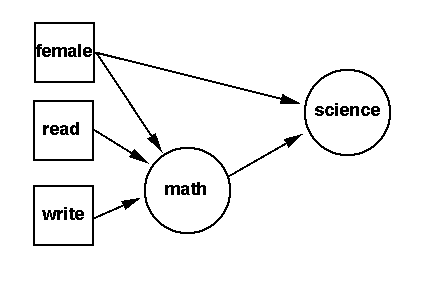
with squares for the exogenous variables and circles for the endogenous variables.
Let's look at the variable science and the two predicted values, p1 from the ivreg model and p2 from the OLS model.
summarize science p1 p2

    Variable |     Obs        Mean   Std. Dev.       Min        Max
-------------+-----------------------------------------------------
     science |     200       51.85   9.900891         26         74
          p1 |     200       51.85   9.522247   31.15061   75.45872
          p2 |     200       51.85    6.33787   37.83501   67.85739

corr science p1 p2
(obs=200)

             |  science       p1       p2
-------------+---------------------------
     science |   1.0000
          p1 |   0.6387   1.0000
          p2 |   0.6401   0.9977   1.0000
Finally, let's how close we can come to the ivreg results doing our own two-stage regression.
regress math read write female

      Source |       SS       df       MS              Number of obs =     200
-------------+------------------------------           F(  3,   196) =   72.33
       Model |  9176.66954     3  3058.88985           Prob > F      =  0.0000
    Residual |  8289.12546   196  42.2914564           R-squared     =  0.5254
-------------+------------------------------           Adj R-squared =  0.5181
       Total |   17465.795   199  87.7678141           Root MSE      =  6.5032

------------------------------------------------------------------------------
        math |      Coef.   Std. Err.      t    P>|t|     [95% Conf. Interval]
-------------+----------------------------------------------------------------
        read |    .385395   .0581257     6.63   0.000      .270763     .500027
       write |   .3888326   .0649587     5.99   0.000     .2607249    .5169402
      female |  -2.023984    .991051    -2.04   0.042    -3.978476   -.0694912
       _cons |   13.09825    2.80151     4.68   0.000     7.573277    18.62322
------------------------------------------------------------------------------

predict pmath

regress science pmath female

      Source |       SS       df       MS              Number of obs =     200
-------------+------------------------------           F(  2,   197) =   95.92
       Model |  9624.27766     2  4812.13883           Prob > F      =  0.0000
    Residual |  9883.22234   197  50.1686413           R-squared     =  0.4934
-------------+------------------------------           Adj R-squared =  0.4882
       Total |    19507.50   199  98.0276382           Root MSE      =   7.083

------------------------------------------------------------------------------
     science |      Coef.   Std. Err.      t    P>|t|     [95% Conf. Interval]
-------------+----------------------------------------------------------------
       pmath |   1.007845   .0739996    13.62   0.000     .8619116    1.153778
      female |  -1.978643   1.006591    -1.97   0.051    -3.963721    .0064348
       _cons |  -.1296241   3.987652    -0.03   0.974    -7.993588     7.73434
------------------------------------------------------------------------------

/* this is the ivreg results from above */

Instrumental variables (2SLS) regression

      Source |       SS       df       MS              Number of obs =     200
-------------+------------------------------           F(  2,   197) =   69.77
       Model |  5920.63012     2  2960.31506           Prob > F      =  0.0000
    Residual |  13586.8699   197  68.9688827           R-squared     =  0.3035
-------------+------------------------------           Adj R-squared =  0.2964
       Total |    19507.50   199  98.0276382           Root MSE      =  8.3048

------------------------------------------------------------------------------
     science |      Coef.   Std. Err.      t    P>|t|     [95% Conf. Interval]
-------------+----------------------------------------------------------------
        math |   1.007845   .0867641    11.62   0.000      .836739     1.17895
      female |  -1.978643   1.180222    -1.68   0.095    -4.306134    .3488478
       _cons |  -.1296216   4.675495    -0.03   0.978    -9.350068    9.090824
------------------------------------------------------------------------------
Instrumented:  math
Instruments:   female read write
------------------------------------------------------------------------------
In the first regression, we regressed the endogenous predictor on the three exogenous
variables. In the second regression, we used the predicted math (pmath) as the
instrumented variable in our model. Note that the coefficients in the second regression
and the ivreg are the same, but that the standard errors are different.One final note, it is also possible to estimate this system of equations using three-stage least squares (3SLS). Stata's reg3 command can perform either 2SLS (equivalent to ivreg) or 3SLS and clearly illustrates the two equation nature of the problem.
reg3 (science = math female)(math = read write female), 2sls

Two-stage least-squares regression
----------------------------------------------------------------------
Equation          Obs  Parms        RMSE    "R-sq"     F-Stat        P
----------------------------------------------------------------------
science           200      2    8.304751    0.3035    69.7726   0.0000
math              200      3    6.503188    0.5254   72.32879   0.0000
----------------------------------------------------------------------

------------------------------------------------------------------------------
             |      Coef.   Std. Err.      t    P>|t|     [95% Conf. Interval]
-------------+----------------------------------------------------------------
science      |
        math |   1.007845   .0867641    11.62   0.000     .8372648    1.178424
      female |  -1.978643   1.180222    -1.68   0.094    -4.298981    .3416951
       _cons |  -.1296216   4.675495    -0.03   0.978    -9.321732    9.062489
-------------+----------------------------------------------------------------
math         |
        read |    .385395   .0581257     6.63   0.000     .2711189    .4996712
       write |   .3888326   .0649587     5.99   0.000     .2611226    .5165425
      female |  -2.023984    .991051    -2.04   0.042    -3.972408    -.075559
       _cons |   13.09825    2.80151     4.68   0.000     7.590429    18.60607
------------------------------------------------------------------------------
Endogenous variables:  science math
Exogenous variables:   female read write
------------------------------------------------------------------------------

reg3 (science = math female)(math = read write female)

Three-stage least squares regression
----------------------------------------------------------------------
Equation          Obs  Parms        RMSE    "R-sq"       chi2        P
----------------------------------------------------------------------
science           200      2     8.24223    0.3035   141.6703   0.0000
math              200      3    6.438234    0.5253   221.4518   0.0000
----------------------------------------------------------------------

------------------------------------------------------------------------------
             |      Coef.   Std. Err.      z    P>|z|     [95% Conf. Interval]
-------------+----------------------------------------------------------------
science      |
        math |   1.007845   .0861109    11.70   0.000     .8390704    1.176619
      female |  -1.978643   1.171337    -1.69   0.091    -4.274421    .3171349
       _cons |  -.1296216   4.640297    -0.03   0.978    -9.224436    8.965192
-------------+----------------------------------------------------------------
math         |
        read |   .3772331   .0496322     7.60   0.000     .2799557    .4745104
       write |   .3981663   .0550155     7.24   0.000      .290338    .5059947
      female |  -2.078337   .9617418    -2.16   0.031    -3.963316   -.1933579
       _cons |   13.06158   2.770268     4.71   0.000     7.631958    18.49121
------------------------------------------------------------------------------
Endogenous variables:  science math
Exogenous variables:   female read write
------------------------------------------------------------------------------
Categorical Data Analysis Course
Phil Ender